For two years, everyone in search has suspected that Google's AI Overviews were eating publisher traffic. Now there's causal proof. A randomized field experiment by Saharsh Agarwal of the Indian School of Business and Ananya Sen of Carnegie Mellon University's Heinz College — the first of its kind — found that when an AI Overview appears, outbound organic clicks fall 39.8%, as reported by PPC Land. Not correlation. Not "the algorithm changed." A controlled experiment.
What happened
The researchers recruited 1,065 U.S. desktop Chrome users through Prolific and ran them through a custom Chrome extension between January 7 and February 10, 2026, tracking 68,089 unique searches. Users were randomly split into a control group, a group whose AI Overviews were silently hidden, and a group redirected into Google's AI Mode. Per Search Engine Journal, over 95% of the hide-AI-Overviews group never noticed anything changed — clean experimental conditions.
The results, per PPC Land's report of the study: AI Overviews showed up on roughly 41% of queries, and removing them lifted outbound clicks from 0.37 to 0.62 per search. Search Engine Journal reports zero-click searches jumped from 54% to 72% when an AI Overview was displayed. When the overview sat in position zero — which it did 88% of the time — removing it nearly doubled outbound clicks.
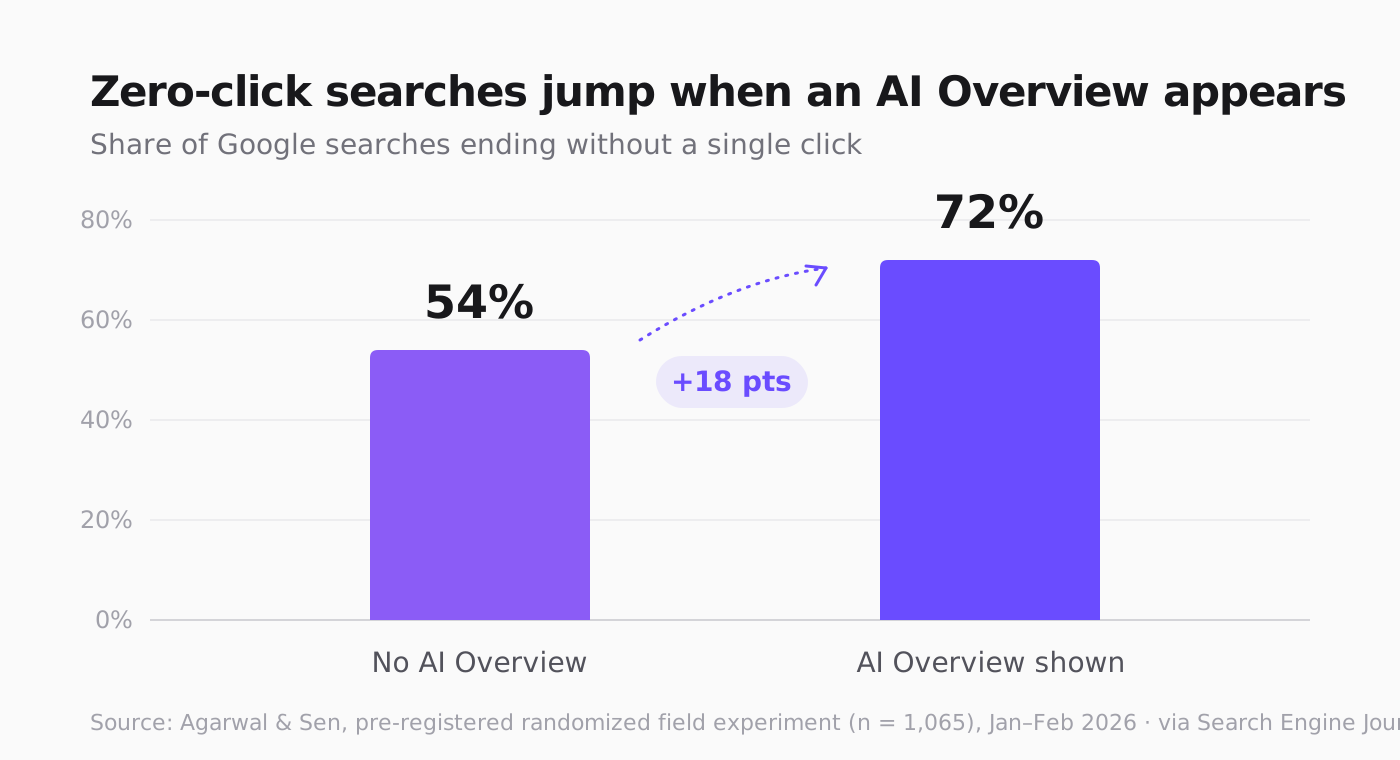 Zero-click share of Google searches, with and without an AI Overview. Data: Agarwal & Sen (2026), via Search Engine Journal.
The paper was posted to SSRN on April 3, 2026, and last revised June 17, 2026. The experiment was pre-registered with the AEA RCT Registry before data collection, so the researchers couldn't cherry-pick outcomes after the fact.
Why it matters
Every previous study on AI Overview traffic loss was observational — Google could (and did) wave it away as confounded by algorithm updates or market shifts. This one isolates the mechanism. And it lands while the European Commission's formal probe into Google (opened December 9, 2025) is ongoing and Penske Media pursues antitrust litigation over traffic diversion, per PPC Land.
The most brutal finding isn't even the click loss. The study found no measurable improvement in user satisfaction — "precisely estimated nulls" on satisfaction, perceived information quality, and ease of finding information. Users aren't happier. Publishers are just poorer.
AI Overviews "divert traffic away from publishers without delivering measurable improvements in user experience." — Agarwal & Sen, via Search Engine Journal
What this means for SaaS founders
 Your buyers still search — they just stop at the answer. Photo from Pexels.
If your acquisition model still assumes people click through ten blue links to find you, this study is your memo that the assumption is dead — causally, rigorously dead. Nearly three out of four searches with an AI Overview now end without a single click.
But here's the flip side: the answer box didn't kill demand, it relocated it. The buyers are still searching — they're just taking the recommendation straight from the AI's mouth. The brands named inside that answer capture the deal flow that used to spread across the SERP. That's the whole game now: stop optimizing to be a link under the answer, start engineering your presence to be in the answer — in AI Overviews, ChatGPT, Perplexity, Gemini, and Grok — for the money prompts your customers actually type.
The bottom line
The first randomized evidence confirms what the traffic graphs were whispering: ~40% of your organic clicks evaporate the moment an AI answer appears, and users don't miss you. The window to become the brand AI recommends — instead of the link it buries — is open right now. It won't stay open for the slow.